
Marrakech doesn’t hand itself over easily to first-time visitors. The old city’s medina is a genuine labyrinth — narrow, unmarked, occasionally disorienting even with a phone in hand — and the modern districts beyond its walls operate on an entirely different rhythm. Choosing where to stay shapes the whole trip more than in most cities, because Marrakech’s neighborhoods aren’t just geographically distinct, they’re experientially distinct. A riad tucked into the medina’s souks delivers a completely different week than a resort in the Palmeraie’s palm groves. Here’s an honest breakdown of the main areas, and who each one actually suits.
Why Neighborhood Choice Matters More in Marrakech

In many cities, “where to stay” is mostly a question of proximity to sights and transit. In Marrakech, it’s also a question of pace and sensory experience. The medina is loud, dense, and alive with commerce well into the evening — a place where getting pleasantly lost is part of the appeal for some travelers and a genuine source of stress for others. The newer districts outside the walls, by contrast, feel closer to a contemporary Mediterranean city, with wider streets, easier taxi access, and a calmer register.
Neither is objectively better. The right choice depends on what kind of trip you’re building.
Medina: The Historic Heart
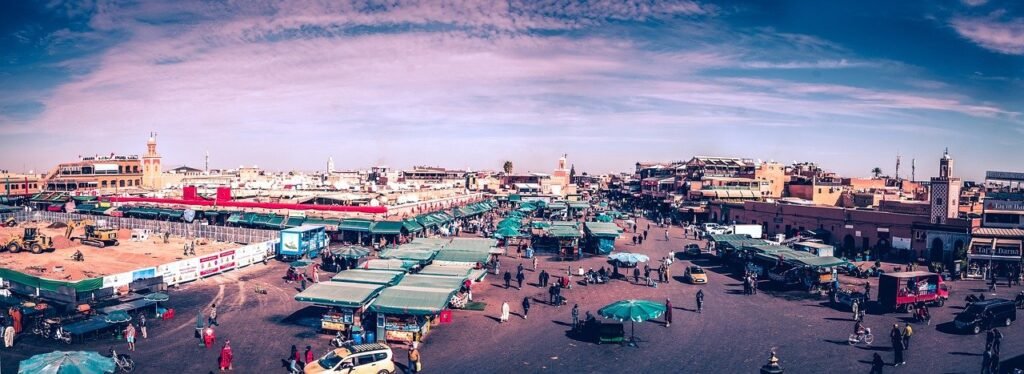
The medina — Marrakech’s walled old city — is where most visitors imagine themselves when they picture a riad stay: a carved wooden door opening onto a quiet courtyard with a fountain, tucked just steps from a souk selling lanterns, leather, and spices.
The area around Jemaa el-Fna, the medina’s central square, is the most atmospheric and the most intense — snake charmers, food stalls, and performers by night, easy access to the souks and the Koutoubia Mosque by day. Staying here means you’re a short walk from nearly everything in the old city, but also close to genuine noise and crowds, particularly in the evening.
For travelers who want the medina experience without quite as much intensity, the Mouassine district — a subsection of the medina slightly north and west of Jemaa el-Fna — offers a calmer, still-historic alternative with its own smaller souks and a reputation for well-restored riads.
**Best for:** First-time visitors who want to be immersed in the old city’s atmosphere, travelers prioritizing walkability to souks and major historic sites, and anyone comfortable navigating (or getting productively lost in) narrow alleyways.
**Trade-offs:** Noise, especially near Jemaa el-Fna; taxis can’t reach most riad doorsteps directly, meaning some walking with luggage; navigation can be genuinely confusing on a first visit.
Kasbah: Traditional and Slightly Quieter
South of Jemaa el-Fna, the Kasbah district offers a similarly traditional, market-driven atmosphere to the wider medina but with a noticeably calmer feel — generally cited as around a ten-minute walk from the main square. This is also where you’ll find the Bahia Palace and the Saadian Tombs, two of the city’s most-visited historic sites.
Local markets in the Kasbah run daily, selling everyday goods rather than primarily tourist items, which gives the area a more lived-in feel than the souks closer to Jemaa el-Fna.
**Best for:** Travelers who want an authentic, traditional riad experience with somewhat less foot traffic and noise than the medina’s core, and easy access to the Bahia Palace and Saadian Tombs.
**Trade-offs:** Still within the medina’s walls, so the same navigation quirks apply, and it’s a bit further from the main souks.
Gueliz: The Modern City Center
Across the ramparts, Gueliz — the heart of the ville nouvelle, or “new city” — is Marrakech’s modern downtown, built during the French colonial period and now home to art galleries, contemporary boutiques, and a livelier, more Western-leaning café and nightlife scene.
Gueliz and neighboring Hivernage are notably easier to navigate by taxi and bus than the medina, since the streets are wider and laid out in a more conventional grid.
**Best for:** Travelers interested in contemporary art and design, those who prefer straightforward navigation and easy transport, and anyone wanting a change of pace from the medina after a few days.
**Trade-offs:** Less immediately atmospheric than the medina; you’ll need transport to reach the main historic sites and souks, which are a taxi ride rather than a walk away.
Hivernage: Upscale and Central-Adjacent
Just outside the medina walls, Hivernage is a compact, modern district known for stylish hotels, upscale restaurants, and a lively bar and nightlife scene. It sits close enough to the medina to reach major sights without much difficulty, while still offering the wider streets and contemporary feel of the ville nouvelle.
**Best for:** Travelers wanting upscale, modern accommodation within easy reach of the medina, and those prioritizing restaurants and nightlife alongside sightseeing.
**Trade-offs:** Less traditional character than a medina riad stay; this is a district built around hotels rather than historic architecture.
Palmeraie: Resort Seclusion
North of the city, the Palmeraie is a palm oasis that has been developed into a luxury resort zone — sprawling hotel grounds and private villas set among date palms and olive groves, roughly a 20-minute drive from the medina.
This is the district for travelers who want Marrakech as a backdrop rather than a daily immersion — pool-focused resort stays with spa access and quiet grounds, rather than souk-adjacent exploring.
**Best for:** Travelers prioritizing relaxation, resort amenities, and privacy over walkable access to the city center; honeymooners and travelers combining Marrakech with a broader Morocco itinerary who want a restful bookend.
**Trade-offs:** Genuinely isolated — a taxi is necessary for essentially everything, including dinner, and the back-and-forth adds both time and cost if you plan to spend significant time in the medina.
How to Choose: A Quick Framework
**First time in Marrakech, want the classic riad experience:** Medina (near Jemaa el-Fna for energy, Mouassine or Kasbah for a calmer version of the same thing).
**Returning visitor, or want a break from medina intensity:** Gueliz or Hivernage.
**Want a resort-style relaxation trip with the city as an occasional outing:** Palmeraie.
**Traveling with young children or heavy luggage and want easier logistics:** Gueliz or Hivernage, where taxis can reach your door.
Many travelers on a longer trip split their stay — a few nights in a medina riad for atmosphere, followed by a few nights in Gueliz, Hivernage, or the Palmeraie for a change of pace. This is a genuinely good strategy if your schedule allows it, since it avoids having to choose only one side of the city’s personality.
Practical Notes on Staying in the Medina
A few practical realities are worth knowing before booking a medina riad specifically:
**Luggage logistics.** Most riads are accessible only on foot via narrow alleyways. Many properties arrange a porter to meet you at the nearest accessible point for cars or taxis, but it’s worth confirming this with your riad ahead of arrival rather than assuming.
**Noise levels vary by exact location.** A riad two minutes from Jemaa el-Fna will be noisier at night than one ten minutes away in a quieter residential pocket of the medina — it’s worth asking directly about proximity to nightlife and the square when booking.
**Rooftop terraces are common and worth using.** Most riads are built around a central courtyard with a rooftop terrace, often the best place to get a sense of the medina’s skyline and call to prayer at sunset.
Common Mistakes to Avoid
**Booking a medina riad without confirming how you’ll get your luggage there.** Taxis often cannot reach the door, and this catches first-time visitors off guard.
**Assuming all “riads” are equally traditional.** The term gets used loosely by some modern guesthouses; if traditional architecture and a historic building matter to you, check specifically.
**Underestimating how isolated the Palmeraie is.** It’s a wonderful choice for a resort-style stay, but a poor choice if daily access to the medina and souks is a priority.
**Not accounting for seasonal heat when choosing a district.** In summer, a pool-focused property in Gueliz, Hivernage, or the Palmeraie can be a meaningfully more comfortable choice than a medina riad without a pool.
FAQ
**Is it safe to stay in the Marrakech medina?** The medina is generally considered safe for tourists, with a visible police presence in main tourist areas. As in any dense, crowded urban area, standard precautions around pickpocketing and overly persistent vendors apply.
**How far is the Palmeraie from the medina?** Roughly a 20-minute drive, depending on traffic — not walkable, and taxis or arranged transport are effectively required for any trip into the city center.
**Which area is best for a first-time visitor?** Most first-time visitors are well served by the medina, ideally Mouassine or a quieter pocket near Jemaa el-Fna, for the full immersive experience — with the option to add a night or two in Gueliz or Hivernage for contrast.
**Can I walk between neighborhoods, or do I need taxis?** Within the medina, walking is standard and often the only option. Between the medina and Gueliz, Hivernage, or the Palmeraie, a taxi or arranged transfer is the norm — these are meaningfully separate districts, not adjacent walkable areas.
**Is Hivernage or Gueliz better for nightlife?** Both have active restaurant and bar scenes, with Hivernage generally considered the more upscale and hotel-centric of the two, and Gueliz offering a broader mix of galleries, cafés, and local nightlife.
**Do riads have air conditioning?** Many modern and renovated riads do, but it’s worth confirming directly, especially for summer travel, since older or smaller properties may rely more on the traditional cooling effects of the courtyard design.
Related Travytour guides
- [Fes or Marrakech: Which Should You Visit First in Morocco?](/fes-or-marrakech-first-visit/)
- [Sahara Desert Tour from Marrakech: What to Actually Expect](/sahara-desert-tour-marrakech-what-to-expect/)
- [Chefchaouen Day Trip from Fes: Is It Worth the Long Drive?](/chefchaouen-day-trip-from-fes/)
Conclusion
There’s no single “best” neighborhood in Marrakech — only the one that matches the trip you’re actually trying to take. If immersive atmosphere and walkable souks matter most, the medina delivers in a way no other district can. If ease of movement and a slower pace matter more, Gueliz, Hivernage, or the Palmeraie are worth serious consideration. Before booking, it’s worth mapping out roughly how you want to split your days between exploring and resting — that answer, more than any list of neighborhoods, should guide where you stay.