Packing for two weeks is a different problem than packing for a weekend or for three months, and the backpack that works well for one length of trip often disappoints on another. Two weeks is long enough to need real capacity and organization, but short enough that a giant expedition pack becomes more burden than benefit. Rather than pointing to a specific model — which will be outdated or repriced by the time you read this — this guide covers the criteria that actually determine whether a backpack will serve you well, so you can evaluate whatever’s currently available against a framework that doesn’t go stale.
Fit and airline-rule note: no backpack is universally “carry-on compliant.” Cabin-bag dimensions and weight limits are airline- and fare-specific, so measure the packed bag and check every carrier on the itinerary before relying on a product label.
Why the Right Backpack Actually Matters
A backpack is the piece of travel gear you interact with the most — every train platform, cobblestone street, and hotel staircase for two straight weeks. A poor match between backpack and traveler shows up as sore shoulders, an inability to find anything without unpacking the whole bag, or a frustrating scramble at airport check-in because the bag doesn’t actually meet the carry-on dimensions it claimed to. Getting the criteria right matters more than getting a specific brand name right, since the “best” backpack varies by body type, trip style, and destination.
The Criteria That Actually Matter
1. Capacity (liters). For a two-week trip, most travelers land somewhere between 35 and 50 liters, depending on climate, trip style, and how much you plan to layer or buy along the way. As a rough guide: warm-climate, minimalist packing can work in the 35–40 liter range; trips involving layered clothing, mixed climates, or bulkier gear (hiking layers, a light jacket, dressier options for evenings) often need 45–50 liters. Going much larger than that for a two-week trip usually means you’re either packing more than necessary or planning to check the bag anyway, which changes the calculus for carry-on-focused travelers.
2. Carry-on compliance. If you want to avoid checked baggage, this is the single most important spec to verify — and the one most likely to trip people up, because airlines don’t share a universal standard. Carry-on size limits vary by airline and by route (particularly between full-service carriers and budget carriers), and limits can differ for the same airline on domestic versus international routes. A backpack advertised as “carry-on size” by its maker isn’t automatically compliant with every airline you might fly. Check the specific dimension limits (not just liters) for every airline on your itinerary before you buy, and note that a backpack that expands (via a zippered gusset) may exceed carry-on limits when expanded even if it complies when compressed.
3. Suspension system. This is the harness, hip belt, and frame structure that transfers weight from your shoulders to your hips and determines whether a fully loaded bag feels manageable or miserable over a full day of walking. A padded, adjustable hip belt is worth prioritizing for any bag over roughly 30–35 liters, since hips are built to carry load far better than shoulders alone. Torso length adjustability matters too — a suspension system sized for the wrong torso length undermines even a well-padded harness. If possible, try a bag on loaded with actual weight (not empty) before buying, since fit only becomes apparent under real load.
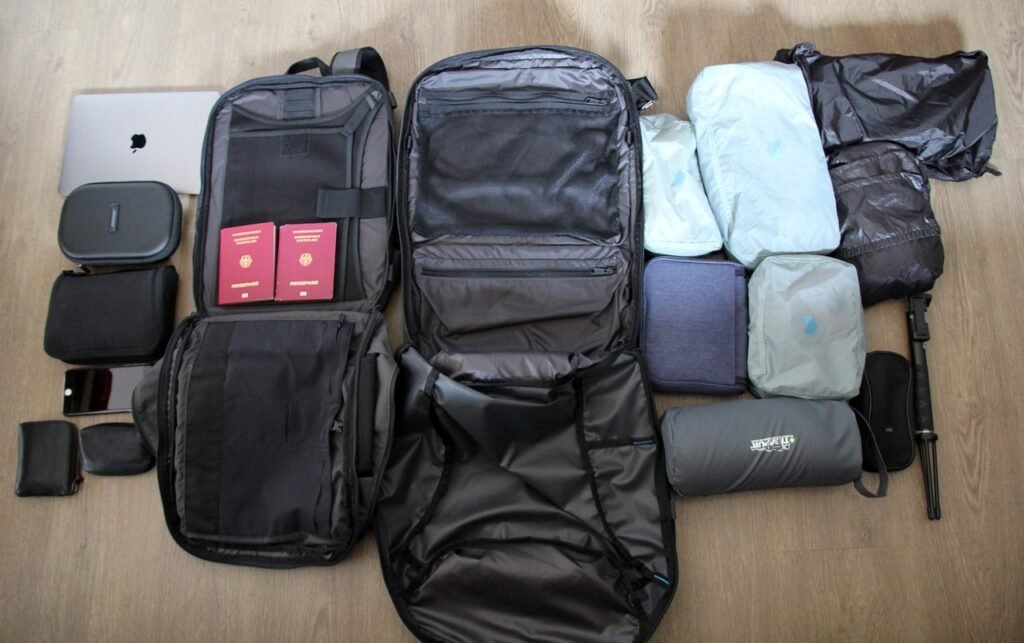
4. Access and organization. Two weeks of clothing and gear is hard to manage in a bag that only opens from the top, since finding anything at the bottom means unpacking everything above it. A front-loading or “suitcase-style” panel that unzips fully flat makes packing cubes and general organization dramatically easier, which matters more over two weeks than it would for a quick overnight trip. Multiple compartments — a dedicated shoe or laundry section, a padded laptop sleeve, easily reachable exterior pockets for documents — reduce daily friction.
5. Durability and materials. Look at the denier rating (a measure of fabric thickness/durability) if it’s listed, along with the quality of zippers, which are usually the first failure point on a heavily used bag. YKK zippers are a commonly cited durability benchmark in the bag industry, though zipper quality alone doesn’t guarantee overall bag durability. Water-resistant (not necessarily fully waterproof) fabric is a reasonable expectation at most price points and helps protect contents during light rain or unexpected spills.
6. Lockability. For travelers who want to secure a bag in transit or in shared accommodation, look for compatible zipper pulls that accept a small TSA-approved lock, or a bag with a dedicated lockable compartment. This is a modest feature but one that’s either present or absent by design — it can’t be easily added after the fact.
7. Weight of the empty bag itself. A heavier-built bag eats into your effective packing capacity before you’ve added anything to it, particularly relevant if you’re trying to stay under a strict carry-on weight limit (a separate constraint from carry-on size, enforced by many international and budget carriers).
8. Comfort features specific to how you’ll actually use it. Breathable back panels matter more in hot climates; a bag that converts between backpack and duffel/wheeled formats offers flexibility for travelers who don’t want to commit to carrying it on their back for an entire trip.
A Step-by-Step Approach to Choosing
- Start with your trip profile, not the bag. Climate, activity level (city-hopping versus hiking-inclusive), and whether you’ll be checking the bag or carrying it on should drive the liter range you’re shopping in.
- Set your carry-on constraint first, if that’s a priority. Check the strictest airline on your itinerary’s dimension and weight limits before shopping, and shop to that number rather than a generic “carry-on size” label.
- Try bags on loaded, not empty, ideally at a store that will let you add sandbags or weights to simulate a real pack. If buying online, prioritize retailers with a reasonable return policy given how much fit matters.
- Prioritize the suspension system and organization over brand recognition. These are the features that determine daily comfort and usability far more than logo or reputation.
- Check current pricing and availability directly with retailers at time of purchase, since backpack pricing shifts with new model releases, seasonal sales, and regional availability — any figure quoted in an article risks being outdated by the time you’re shopping.
Actionable Tips
- Pack the bag you’re considering (or a similar volume) with a practice load before your trip, not for the first time at the airport, so you know how it actually distributes weight.
- Weigh the loaded bag at home if you’re trying to stay under an airline’s carry-on weight limit — bathroom scales work fine for this with a simple lift-and-subtract method.
- Compress, don’t just stuff. Packing cubes or compression sacks help you use a bag’s full capacity efficiently and keep items from shifting, which affects both organization and how evenly weight sits against your back.
- Test the hip belt and sternum strap adjustment before travel day, since dialing in fit under time pressure at a train station is far harder than doing it at home.
- Consider a smaller daypack or packable tote as a companion piece for day trips, so you’re not carrying your full two-week load around a single destination each day.
Common Mistakes to Avoid
Buying based on liters alone without checking dimensions. Two bags with the same liter capacity can have very different external dimensions, and dimensions — not liters — are what airlines actually measure.
Assuming “carry-on size” claims apply universally. This label is not standardized across airlines; verify against your specific carriers’ published limits.
Overbuying capacity “just in case.” A larger bag doesn’t just weigh more empty — it invites overpacking, which compounds the weight problem rather than solving it.
Skipping the loaded fit test. An empty bag can feel comfortable in a store and still be miserable once loaded with two weeks of gear; weight distribution only becomes apparent under real load.
Ignoring the return or warranty policy. Backpacks are subjected to heavy real-world use, and a bag that fails at the six-month mark is a different problem than one that fails on day three of a trip — check what recourse you have either way before buying.
Frequently Asked Questions
What size backpack do I need for a two-week trip? Most travelers find 35–50 liters sufficient, depending on climate and packing style. Warmer, minimalist trips can work with less; trips requiring layered clothing or bulkier gear typically need more.
Is a wheeled bag or a backpack better for two weeks? It depends on your itinerary. Backpacks are generally better for trips involving uneven terrain, multiple transit changes, or stairs-heavy cities (many older European train stations and guesthouses lack elevators). Wheeled bags can be more comfortable on smooth terrain and for travelers who prefer not to carry weight on their back at all.
Do I need a bag specifically labeled “carry-on” to avoid checking luggage? Not necessarily, but you do need a bag that fits within your specific airline’s actual size and weight limits, which the “carry-on” label doesn’t guarantee across every carrier. Always verify dimensions against your specific flights.
How much should I expect to spend on a quality travel backpack? Pricing varies widely by brand, materials, and features, and changes over time with new releases and sales. Rather than anchoring to a specific figure, focus on the criteria in this guide (suspension system, durability, organization) and compare current options against your budget at the time of purchase.
What’s the difference between a hiking backpack and a travel backpack? Hiking packs are generally optimized for outdoor load-carrying over rough terrain, with features like external attachment points and different suspension geometry. Travel packs are generally optimized for urban use, security features, and suitcase-style access. Some hybrid packs serve both purposes reasonably well, but a true hiking pack isn’t always the most convenient choice for city-based travel.
Should I buy packing cubes separately, or are they included with most travel backpacks? Packing cubes are almost always sold separately. They’re a worthwhile add-on for any bag over roughly 35 liters, since they make organization and compression significantly easier over a two-week trip.
Where to Go From Here
Rather than chasing a single “best” backpack recommendation, use the criteria above to evaluate whatever’s currently available in your budget range against your specific trip profile — climate, itinerary, and whether carry-on compliance matters to you. A bag that fits your actual trip will outperform a highly rated bag that doesn’t.
Related Travytour guides
- Travytour Trip Budget Calculator
- All Travytour Travel Guides
- How to Pack for a 3-Week Trip in a Carry-On Only
Keep planning
- More Global Travel guides on Travytour
- Estimate your own trip cost with the Travytour budget calculator
- Browse all Travytour travel guides